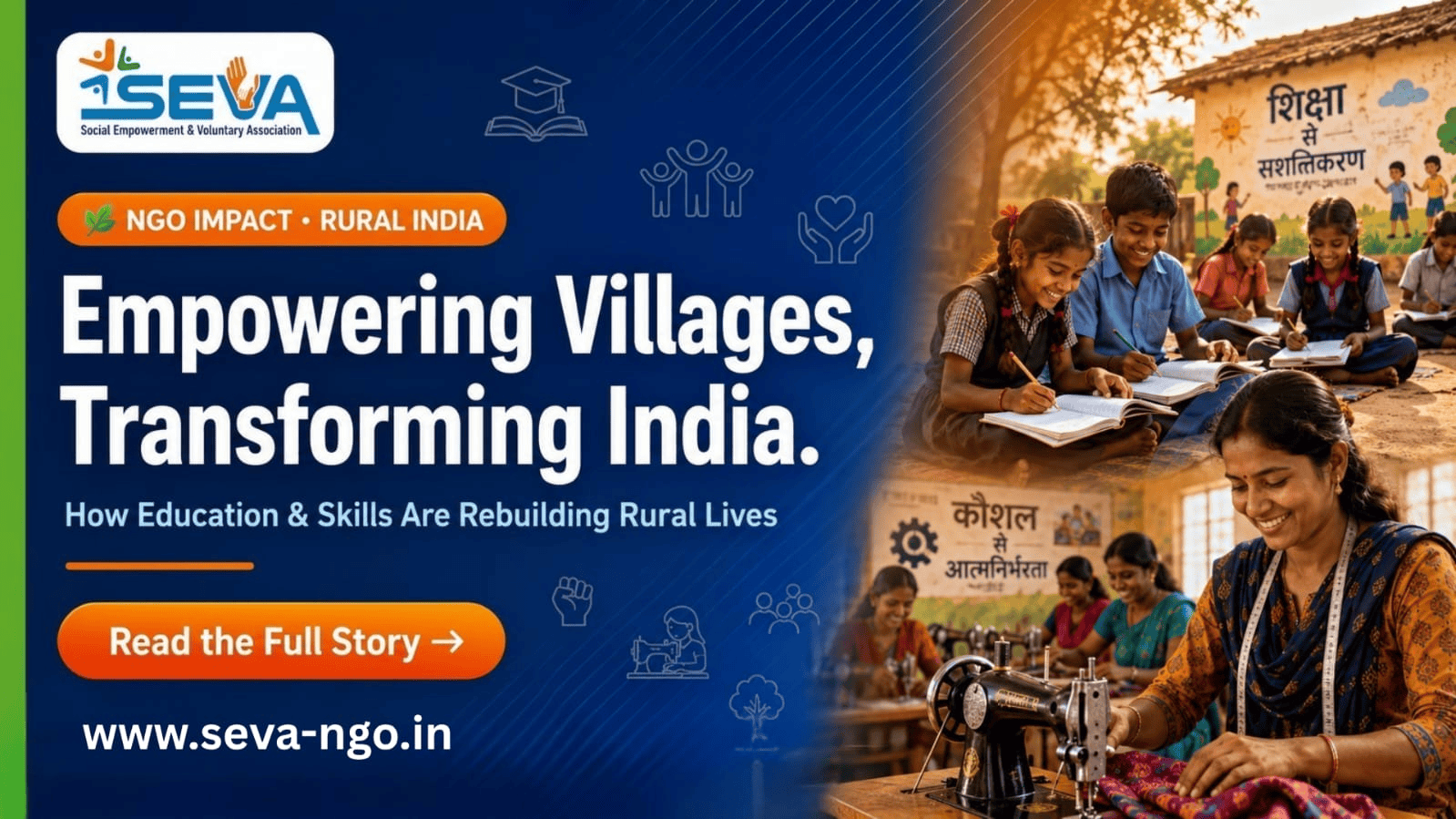
Across the vast stretches of rural India from the tribal villages of Jharkhand to the drought prone hamlets of Vidarbha a quiet revolution is unfolding. It is not led by governments alone, nor driven purely by corporate investment. It is being powered by Non Governmental Organizations (NGOs) that work at the grassroots level, one family, one school, and one skill at a time.
India is home to more than 3 million registered NGOs, making it one of the largest civil society ecosystems in the world. Many of these organizations have turned their focus to two of the most critical drivers of long term prosperity education and skill development. And the results, when implemented thoughtfully and sustainably, are transforming entire communities.
Community development sits at the heart of this transformation. When children gain access to quality education and young adults acquire marketable skills, families break cycles of poverty that have persisted for generations. Local economies grow. Women gain financial independence. And villages that once depended entirely on agriculture begin to diversify their livelihoods.
Key Takeaways
- NGOs are filling critical education and skill gaps in rural India that government programs alone cannot address.
- Community development is most effective when it is locally owned, culturally sensitive, and multi-generational in focus.
Vocational training programs tied to local market demand dramatically improve employment outcomes for rural youth.
Women's empowerment initiatives embedded within education programs create compounding benefits for entire households.
Technology including mobile learning platforms and digital literacy programs is accelerating NGO impact in remote areas.
Sustainable development requires long-term funding models, community buy-in, and robust monitoring frameworks.
The Education Gap in Rural India : Why NGOs Matter
Despite significant progress since independence, India still faces a stark education divide between urban and rural populations. According to data from the Annual Status of Education Report (ASER), a substantial proportion of Class 5 rural students cannot read a Class 2 level text fluently. Dropout rates, particularly for girls, spike during the transition from primary to secondary school
Government programs like Samagra Shiksha and the Mid-Day Meal Scheme have made meaningful contributions but they often struggle with last mile delivery, teacher absenteeism, and infrastructure gaps. This is precisely where NGOs step in.
Bridging the Learning Gap with Community-Centered Schools
Organizations like Pratham, Teach For India, and Vidya Bhavan Society have pioneered a model of community centered learning that puts the child not the curriculum at the center. Rather than replicating urban classroom structures in rural settings, these NGOs design their pedagogy around local languages, cultural references, and real world problem solving.
Pratham's "Teaching at the Right Level" (TaRL) approach, for example, groups children by learning ability rather than age or grade. This seemingly small shift has produced measurable improvements in foundational literacy and numeracy across multiple Indian states and has been adopted internationally as a model of educational community development.
Keeping Girls in School
One of the most significant contributions of rural-focused NGOs is their work on girls' education. Organizations like Nanhi Kali (supported by the Mahindra Foundation and KC Mahindra Education Trust) provide academic support, study material, and mentoring to underprivileged girls specifically to reduce dropout rates.
The ripple effects of keeping girls in school extend well beyond literacy. Educated girls are more likely to delay marriage, have fewer and healthier children, earn higher incomes, and invest more in their own children's education making girls' education one of the highest return interventions in social change in India.
Skill Development: Building Livelihoods, Not Just Literacy
Education alone is not enough. A young person who completes Class 10 in rural Rajasthan but has no vocational training and no job market connection remains economically vulnerable. This is why the most effective NGO programs today integrate skill development directly alongside or immediately following formal education.
Vocational Training Tied to Market Demand
The key differentiator of successful skill development programs is market linkage. NGOs like BASIX, Grameen Foundation India, and Mann Deshi Foundation don't just teach skills they actively study local and regional job markets to determine which trades have genuine employer demand before designing their curricula.
Programs cover trades ranging from solar panel installation, tailoring, computer literacy, plumbing, and nursing assistance to agricultural entrepreneurship. When training is matched to real demand, placement rates improve dramatically and with them, the long term sustainability of community development outcomes.
Women's Self-Help Groups as Skill Hubs
Self Help Groups (SHGs), often formed and supported by NGOs, have become powerful nodes for skill transmission in rural India. Organizations like SEWA (Self Employed Women's Association) and Mahila Chetna Manch have used SHGs not just as microfinance vehicles, but as learning communities where women teach each other new trades, share market information, and collectively negotiate better prices for their products.
This peer learning model reduces the cost of skill training while increasing social cohesion a dual benefit that institutional training programs rarely achieve.
How NGOs Drive Sustainable Community Development
The Grassroots Approach
The most enduring NGO impact comes not from external expertise parachuted into communities, but from programs that build local leadership capacity. When an NGO trains a village woman to become a community health worker, or empowers a local teacher to deliver remedial education, the knowledge stays in the village long after the NGO project ends.
This principle often called "building community ownership" is central to sustainable development frameworks endorsed by organizations like the United Nations Development Programme (UNDP) and NITI Aayog's voluntary sector guidelines.
Integrating Technology for Scale
Digital tools have opened new frontiers for rural education and skill development. Organizations like Digital Empowerment Foundation and iDiscoveri Education are deploying tablet-based learning, WhatsApp learning groups, and community radio programs to reach learners in areas where roads and physical infrastructure remain unreliable.
During and after the COVID-19 pandemic, many NGOs rapidly pivoted to hybrid models combining inperson facilitators with digital content demonstrating the resilience and adaptability that distinguishes effective organizations from rigid ones.
Collaboration with Government and Corporate Partners
Some of the most scalable community development models emerge from tripartite collaborations between NGOs, state governments, and Corporate Social Responsibility (CSR) arms of private companies. Under the Companies Act 2013, Indian companies above a certain size are required to spend 2% of average net profits on CSR activities a mandate that has channeled billions of rupees annually toward education and skill development NGOs.
When these partnerships are designed well with clear accountability, transparent reporting, and genuine community participation they can take successful pilots to district or state level scale.
Expert Insights
Dr. Madhav Chavan
Co-founder of Pratham
He has emphasized that "the first step to improving education outcomes is to honestly assess where children currently are, not where the system assumes they should be." This evidence-first philosophy has influenced NGO program design across India and globally.
Ela Bhatt
Founder of SEWA
long advocated that skill development must be paired with market access and social protection otherwise, skills remain latent. Her work established a model of integrated social change in India that remains a touchstone for development practitioners.
Abhijit Banerjee and Esther Duflo
Co-founder of j-pal
supported rigorous evaluations of NGO programs in India, showing that targeted interventions particularly in early childhood education and female vocational training generate high returns in human capital.
Research from the Indian Institute of Management Ahmedabad on SHG bank linkage programmes found that communities with sustained community development inputs showed 30 40% higher income gains and significantly better social indicators over a 10 year period compared to control groups.
Common Mistakes in Community Development Work
- Imposing External Agendas: Arriving with a predetermined solution a specific crop variety, a particular infrastructure design, a literacy curriculum without participatory needs assessment alienates communities and produces low adoption.
- Ignoring Intra-Community Power Dynamics: India's communities are not homogeneous. Caste hierarchies, gender subordination, and ethnic tensions mean that "the community" often means the dominant group unless deliberate inclusion strategies are applied.
- Short Project Cycles: Three year donor-funded projects are rarely sufficient to build durable institutions. Organisations that shift priorities with each funding cycle leave communities mid journey, eroding the trust essential for sustained change.
- Measuring Outputs Over Outcomes: Counting meetings held, materials distributed, or people trained without measuring whether attitudes, behaviours, and living conditions have actually changed leads to systemic misreporting of NGO impact.
- Neglecting the Youth: Focusing exclusively on women's SHGs or elder leaders without engaging young people limits the intergenerational transfer of community development gains.
Best Development Practices for Sustainable Community in India
- Start with Listening, Not Solutions: Invest deeply in Participatory Rural Appraisal (PRA) or Participatory Learning and Action (PLA) tools before designing any intervention. Communities know their context better than any outsider.
- Build Local Leadership Pipelines: Identify and nurture community leaders especially women, Dalit, and Adivasi individuals who can become the long-term stewards of change.
- Integrate Multiple Dimensions: Siloed interventions in only health, only education, or only livelihood rarely achieve systemic change. The most effective models like Gram Vikas's MANTRA programme in Odisha link water, sanitation, housing, health, and livelihood in a single community owned process.
- Create Accountability Mechanisms: Social audits, community scorecards, and grievance redressal processes ensure that development resources reach intended beneficiaries and that communities can hold institutions accountable.
- Leverage Digital Tools Thoughtfully: Mobile-based financial services, telemedicine platforms, and e governance tools can amplify community development outcomes but only when communities have the digital literacy to use them critically and confidently.
- Document and Share Learning: Community development thrives when successful models are documented in accessible formats local language videos, illustrated manuals, peer-learning exchanges and shared across communities and organisations.
Conclusion
India's development journey cannot be reduced to GDP growth or infrastructure investment alone. True, lasting social change in India requires that the country's most marginalised citizens its women, its Dalits, its Adivasis, its urban poor become not just beneficiaries but protagonists of their own transformation.
community development is not a soft, supplementary activity. It is the foundation upon which sustainable development is built. When communities own the process of change when they diagnose their challenges, design their solutions, manage their resources, and hold power accountable the results endure. They endure because they are not dependent on any single donor, government programme, or NGO.
The evidence from across India from Kerala's Kudumbashree to Rajasthan's water harvesting movements, from Tamil Nadu's SHG networks to Odisha's MANTRA villages is unambiguous: invest in people, build their agency, and the communities will do the rest.